
Should I Text My Ex to Get My Stuff Back During No Contact?
You can text your ex during no contact to retrieve essential belongings, but only as a low-friction logistics transaction. Do not use an old hoodie as an excuse to see them, fish for closure, or test whether they miss you. If an item is easily replaced, let it go.
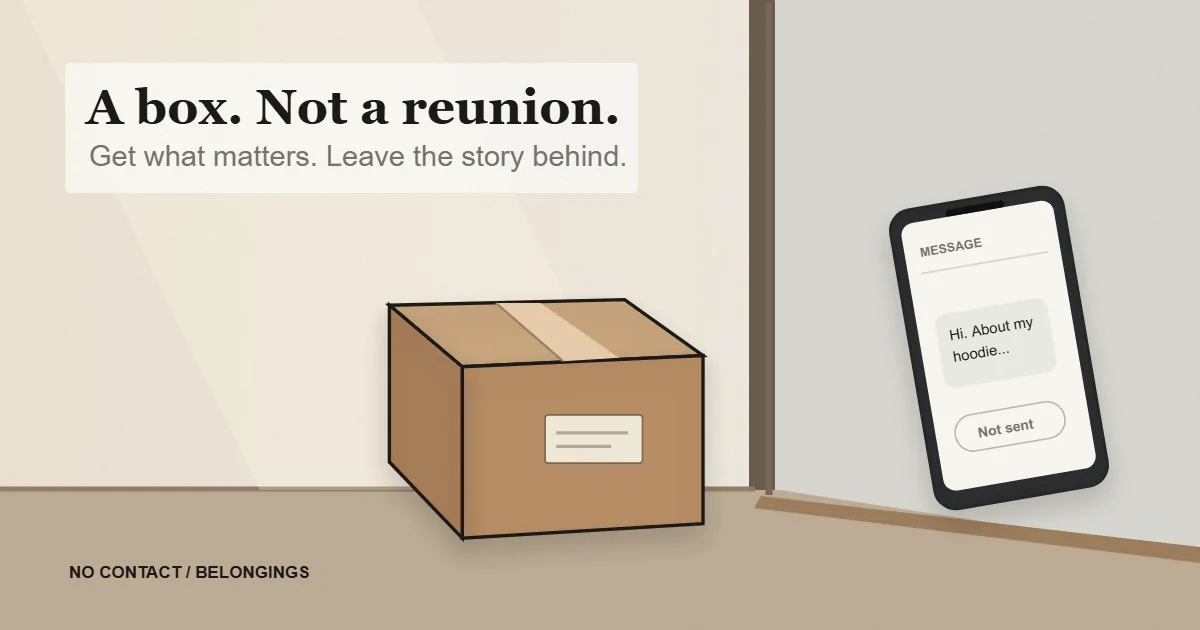
First, be ruthless about why you want the item back
Before you draft a message, pause and inspect your motive.
Your brain will tell you that you desperately need your favorite sweatshirt, that specific water bottle, or the paperback novel sitting on their nightstand.
Ask yourself the uncomfortable question:
Are you trying to retrieve a physical possession, or are you trying to manufacture an excuse for contact?
When people are going through the acute withdrawal of a breakup, the nervous system searches for any socially acceptable reason to reopen communication. A forgotten jacket or a phone charger feels legitimate. It feels practical. It feels safe from rejection because “I’m just asking for my property.”
Here is how to tell the difference:
- If it is truly about the item, you would be completely relieved if they left it in a sealed box on the porch while they were out, so you never had to see their face or exchange a single awkward sentence.
- If it is about contact, the idea of picking up a box on the porch without seeing them feels disappointing, empty, or frustrating.
If you find yourself debating what outfit to wear to pick up a hoodie, you are not running an errand. You are planning a covert reunion audition.
Do not do that to yourself.
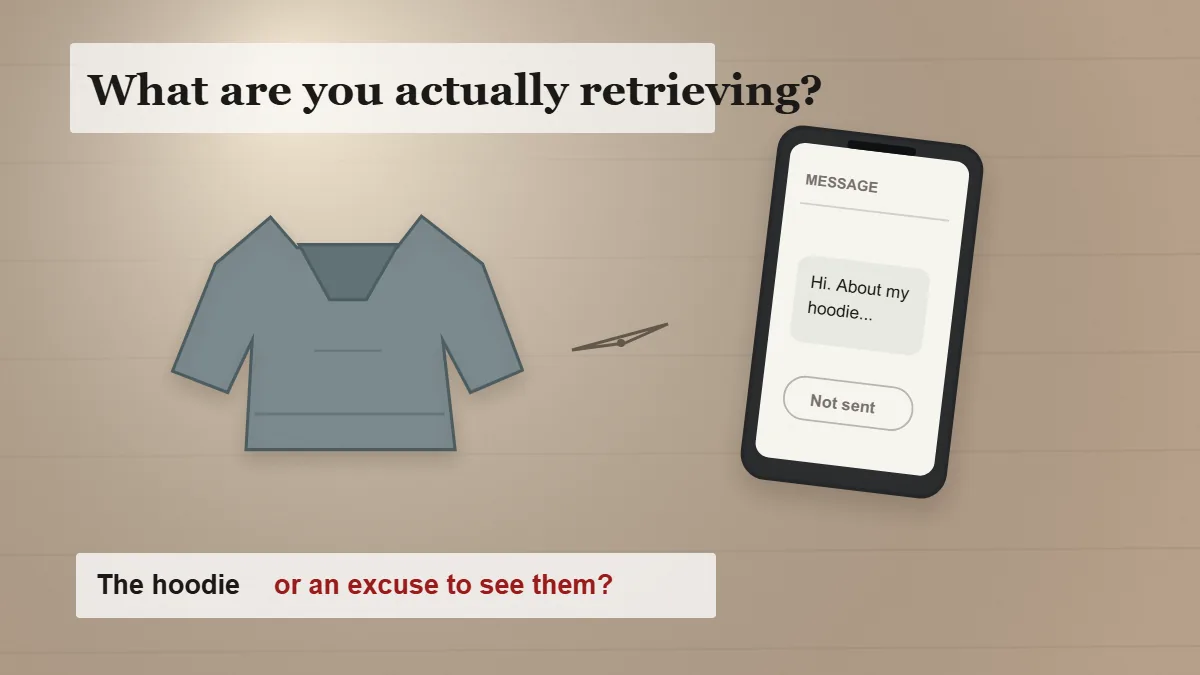
The belongings triage checklist: What to retrieve and what to write off
Not all belongings carry the same weight. Before sending any message, run your missing items through this three-tier filter.
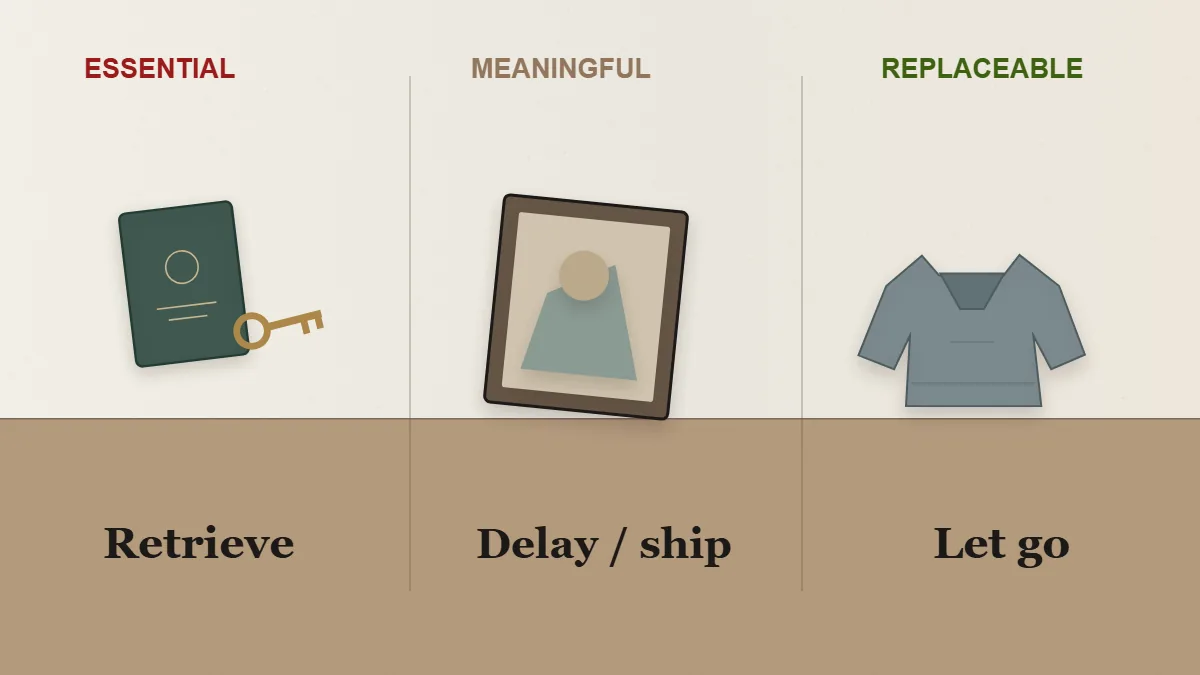
Tier 1: High-stakes essentials (Retrieve immediately)
These are items that directly affect your legal standing, financial security, or daily survival:
- Passport, birth certificate, social security card, or immigration papers;
- Keys to your current apartment, mailbox, or vehicle;
- Work laptop, external hard drives, or confidential business documents;
- Essential prescription medications or medical equipment;
- High-value tools required for your livelihood.
If your ex has these items, you do not need to wait out a 30-day no-contact rule. Send a concise, neutral message immediately. If the breakup was hostile or volatile, arrange for a neutral third party or local authorities to assist with the handoff.
Tier 2: Meaningful or high-value keepsakes (Delay or ship)
These are items that have genuine financial or emotional value, but their absence will not derail your week:
- Irreplaceable family heirlooms or vintage jewellery;
- Expensive musical instruments, cameras, or electronics;
- Sentimental gifts given by relatives who have passed away;
- High-cost furniture or winter coats.
Do not rush to retrieve these in the first 72 hours after a painful breakup when adrenaline is high and tears are inevitable. Wait two to three weeks until the initial shock settles into emotional composure. Then, arrange for a contactless pickup or prepaid courier shipping.
Tier 3: The “Breakup Tax” (Write off and let go)
These are items that are easily purchased again:
- T-shirts, hoodies, socks, or gym shorts;
- Phone chargers, cables, or power banks;
- Books, mugs, water bottles, or umbrellas;
- Half-used toiletries or skincare products.
Consider these items the breakup tax.
Yes, it was your favorite hoodie. Yes, you spent on that charger. But buying a replacement on Amazon takes ninety seconds and zero emotional toll. Reopening a conversation with an ex over a piece of cotton costs sleep, resets your healing clock, and invites days of obsessive rumination.
Your mental peace is worth far more than thirty dollars. Let them keep the hoodie or throw it away.
The three rules of engagement for the text
If you have Tier 1 or Tier 2 items that genuinely must be retrieved, follow three non-negotiable rules when messaging:
Rule 1: Single purpose only
The message must contain nothing except the logistics of property exchange.
- No emotional warmups: Do not start with “Hey, hope you’re doing well” or “I know this is awkward.”
- No apologies: Do not add “Sorry to bother you” or “I hate to message you after everything.”
- No relationship questions: Do not ask how they are feeling, what they have been doing, or whether they have spoken to mutual friends.
Rule 2: Pre-select a low-friction exchange method
Never send an open-ended message like:
“Hey, when are you free to meet up so I can get my stuff?”
An open question forces a negotiation, requires matching schedules, and often leads to an emotionally charged sit-down meeting. Instead, propose a specific, contactless method with a defined time window.
Rule 3: Keep it brief, factual, and polite
State what you need, propose how to transfer it, and offer to return anything of theirs that you currently have.
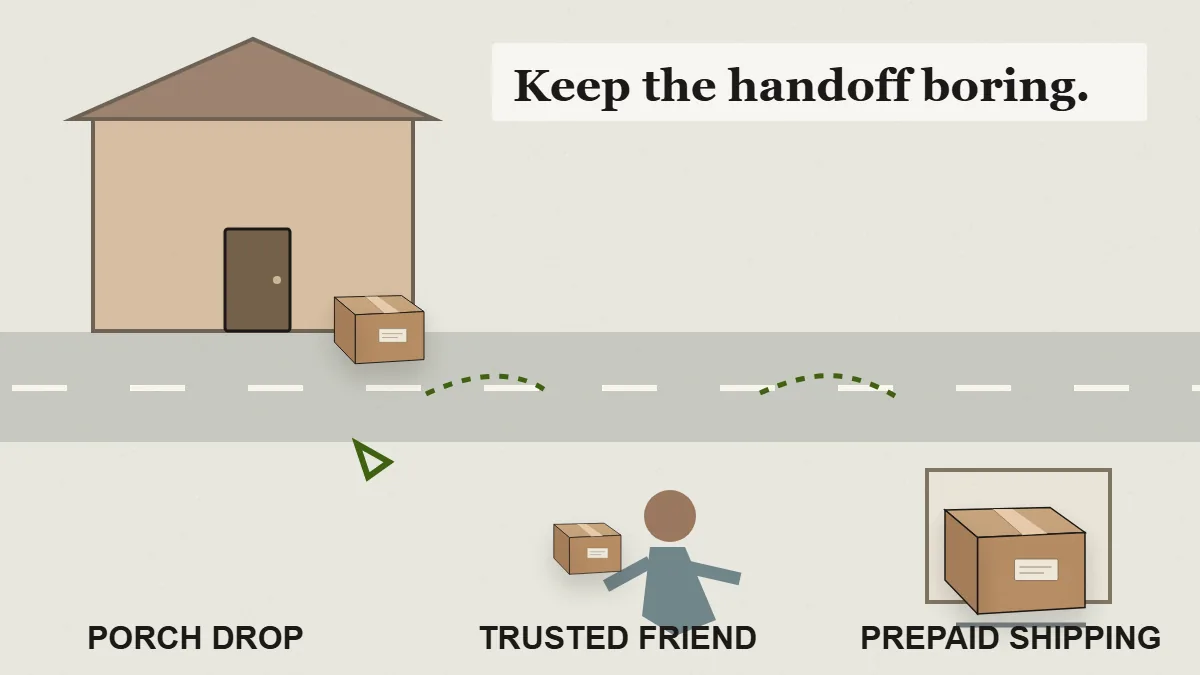
Three neutral text templates
Choose the template that matches your situation. Copy it, fill in the specific items, and send it without adding emojis or extra punctuation.
Template 1: The porch or doorstep drop-off (Best for nearby, civil breakups)
“Hi [Name], I need to collect my [passport / laptop / specific items]. I have your [their items, if any] packed in a box as well. Could you leave my things on the porch on [Day, e.g., Thursday] between [Time window, e.g., 2 PM and 4 PM]? I’ll swap the boxes and leave without knocking. Let me know if that time works.”
Why this works: It removes the dread of an in-person confrontation. Neither person has to open the door, make small talk, or interpret facial expressions.
Template 2: The mutual friend or third party (Best for high-anxiety or volatile breakups)
“Hi [Name], I’d like to retrieve my [specific items]. To make things simple for both of us, [Friend’s Name] offered to pick them up from you this weekend. Could you let [Friend’s Name] or me know when a good time would be for them to stop by?”
Why this works: A third-party buffer completely neutralizes emotional manipulation, false hope, and spontaneous arguments.
Template 3: The prepaid shipping box (Best for distance or complete zero-contact)
“Hi [Name], I need to get my [specific items] back. To save time and keep things easy, I can email you a prepaid shipping label so you can just drop them in a box at the post office. Let me know if that works for you.”
Why this works: You handle the expense, eliminate physical proximity, and turn the exchange into a routine postal transaction.
What to do if they stall, ignore, or demand to meet
If they do not respond within 48 to 72 hours
Do not double-text after six hours. Wait a full three days. If you still have no reply, send one brief follow-up:
“Following up on my previous note regarding my [passport / laptop]. Please let me know when [Friend / courier] can collect it this week.”
If they ignore a second message regarding legally essential property (passports, car titles, birth certificates), do not plead or argue. Contact a local non-emergency police line or legal aid service to request a civil standby escort to retrieve your belongings safely.
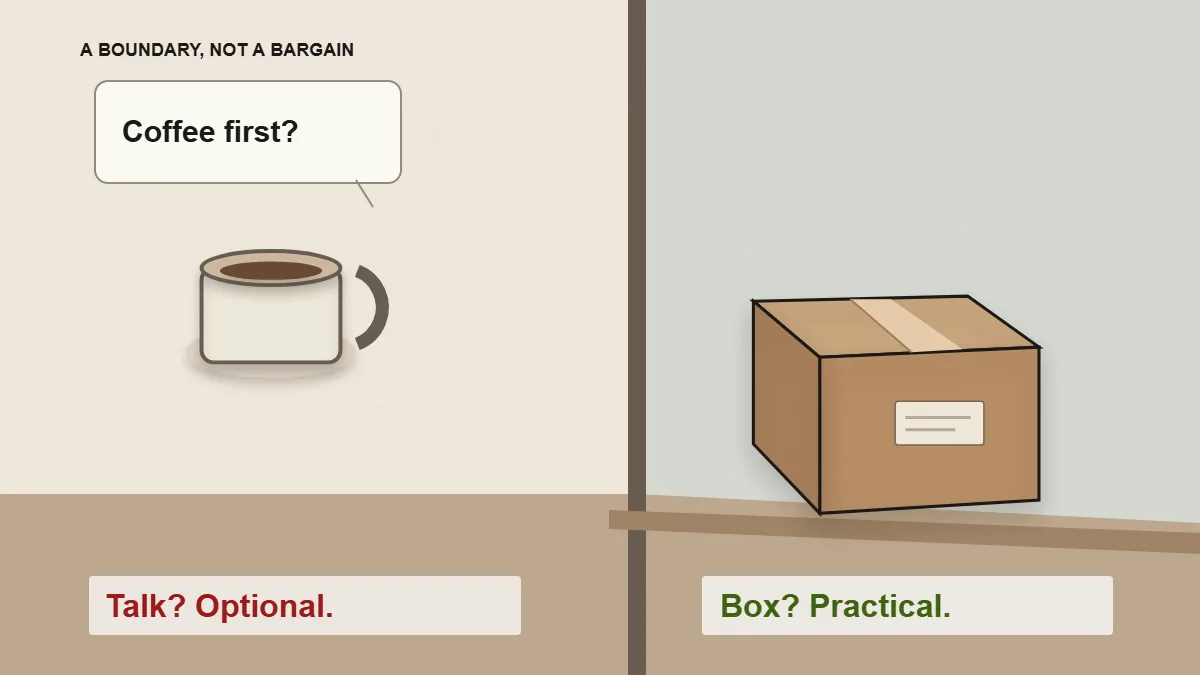
If they insist on meeting for coffee or talking in person
An ex will sometimes use your belongings as a hostage to force an emotional conversation:
“I have your things, but I think we really need to sit down, get coffee, and talk about what happened first.”
If you do not want an emotional conversation, hold your boundary calmly:
“I appreciate you holding onto my things, but I’m not in a place to have a conversation right now. I’d like to keep this strictly to exchanging our belongings. Let me know if the porch drop-off or [Friend’s Name] works best.”
You are under no obligation to pay for your own belongings with an emotional debrief.
Ground your motive before touching the phone
If you find yourself rereading your draft text ten times, checking their social media status before sending, or feeling your pulse race in your throat, step back.
You are attempting to handle a physical errand while your nervous system is in emotional distress.
Before you press send, take two minutes with our free 3-Card No-Contact Reflection Tool. It asks three grounded questions to pull you out of projection:
- The Documented Reality: Is this text driven by a concrete logistical need, or by an urge to disrupt the silence?
- The Hidden Blind Spot: Are you secretly hoping this errand turns into a conversation that repairs the relationship?
- The Grounded Next Action: What choice protects your dignity and emotional baseline today, regardless of how they react?
If the honest answer is that retrieving the item is not about the item, and you need help untangling your motive from the excuse, a written tarot reflection can offer some external distance. It is not a permission slip to turn a missing hoodie into a relationship summit; it is just a structured way to examine the motive you are trying to smuggle through customs.
If you also received unexpected contact from your ex, read our guide on how to handle an ex’s birthday text during no contact, or see what an unblock does—and does not—mean before treating a changed setting as an invitation. For another passive signal, read the LinkedIn profile-view reality check.
The bottom line
Getting your things back is an errand. It is not a romantic scene.
If the items are essential, retrieve them with the quiet efficiency of a delivery service: neutral words, minimal contact, zero debate.
If the items are replaceable, pay the breakup tax, leave them behind, and buy yourself a new one.
Your closure will never arrive in a cardboard box on your ex’s doorstep. It arrives when you stop using physical objects to prolong an emotional goodbye.