
Should I Reply to My Ex’s Happy Birthday Text After No Contact?
You do not have to reply to your ex’s birthday text after no contact. If you want to stay civil and feel steady, send one brief “Thank you” and stop there. Do not add a question, reopen the breakup, or treat a birthday message as proof they want you back.
First, separate the text from the story you built around it
The message may say:
Happy birthday. Hope you’re doing well.
That is the fact.
Your brain may immediately produce a twelve-episode drama:
- They still love me.
- They regret everything.
- They are testing the waters.
- They want me to make the next move.
- If I reply perfectly, we might get back together.
- If I do not reply, I will ruin my only chance.
The brain is very creative when it wants emotional certainty. It can turn three polite words into a full relationship forecast.
Do not let it.
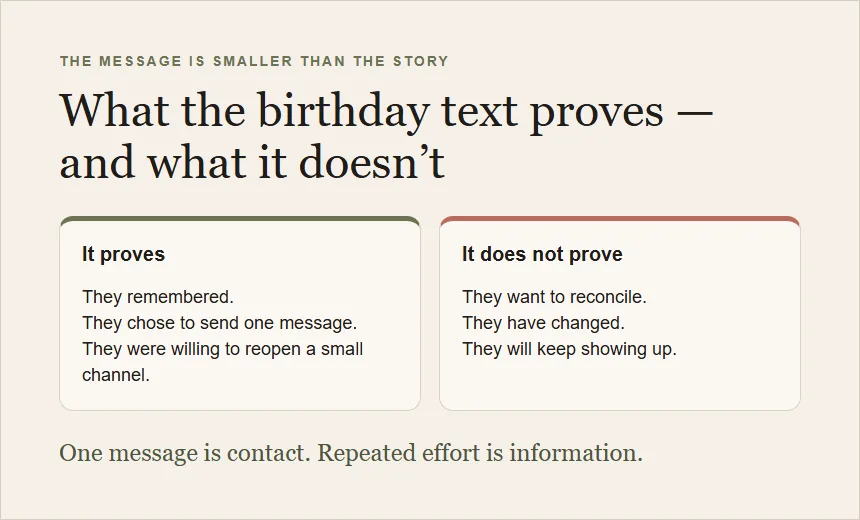
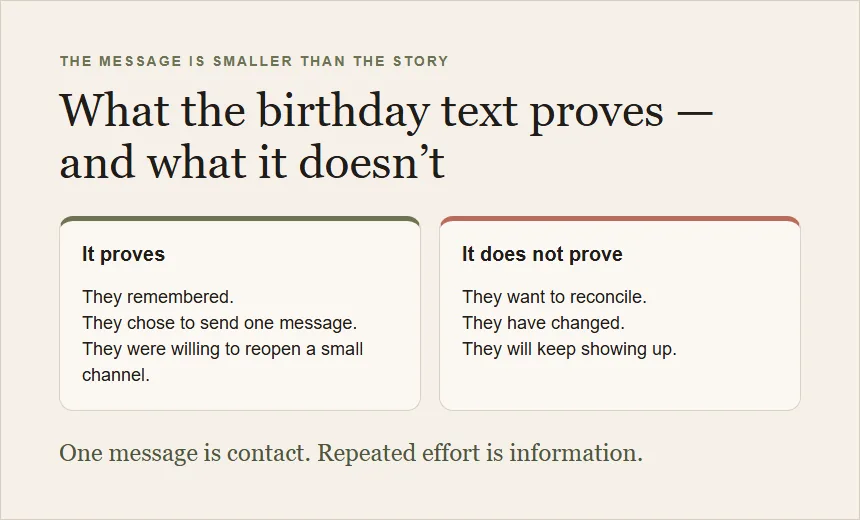
A birthday message proves that your ex sent a birthday message. It may also prove that they remembered the date and felt comfortable making one low-risk contact.
It does not prove that they have changed. It does not prove that they want a relationship. It does not prove that they are ready to discuss what went wrong.
One text is contact.
It is not repair.
What a birthday text actually proves
A birthday message can mean several things:
- basic politeness;
- a moment of nostalgia;
- curiosity;
- an attempt to keep the door slightly open;
- a low-risk way to see whether you respond;
- genuine goodwill with no plan behind it.
You cannot identify the reason from the message alone.
That is the annoying answer. It is also the useful one.
People often want to know what the message “really means” because certainty feels better than waiting. But guessing at your ex’s private thoughts will not protect you. Their next pattern of behavior will tell you more than the birthday text itself.
Look at the evidence in order:
- They sent a birthday message.
- They continued the conversation without making you carry it.
- They showed consistent effort.
- They discussed the breakup honestly.
- They accepted responsibility for specific behavior.
- They proposed a clear next step.
- They followed through over time.
A birthday text lives at the very beginning of that list.
Do not use the emotional weight of your history to inflate the evidential weight of one message.
Your history may be huge.
The message is still one message.
Use the three-outcome test before replying
Before you answer, imagine these three outcomes.
Outcome one: They reply with an emoji
You send:
Thank you. I appreciate it.
They answer:
👍
Or:
😊
Then the conversation dies.
Would you be able to put your phone down and continue your day?
Outcome two: They do not reply at all
You answer politely. They read it. Nothing happens.
No second message. No explanation. No dramatic confession. Just silence.
Would you start checking the chat every few minutes?
Would you wonder whether your reply sounded cold?
Would you draft a second message to “clarify” what you meant?
Outcome three: They suddenly become warm
This one is more dangerous because it feels like a reward.
They say they miss you. They ask how you are. They mention old memories. They act as if the breakup was a temporary clerical error.
Then, a few days later, the energy disappears.
Could you handle that without going back into the same emotional loop?
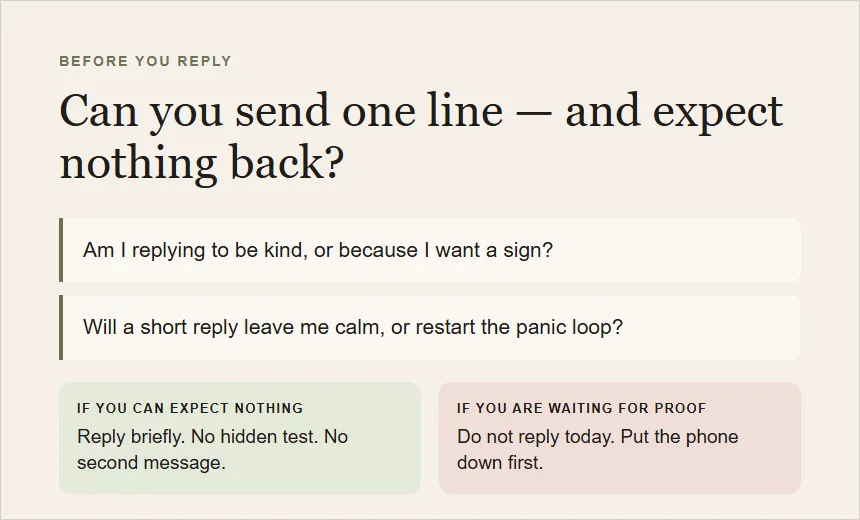
If any of these outcomes would send you into insomnia, phone-checking, or imaginary wedding planning, you do not need to reply immediately.
Waiting is allowed.
Not replying is allowed.
Your ex sent a message. They did not send you a legal summons.
The safest reply depends on your actual goal
The correct reply is not the most clever one. It is the one that matches what you genuinely want.
If you only want to be polite
Send:
Thank you. I appreciate it.
Then stop.
No question. No emotional footnote. No “How have you been?” added at the last second because your thumb got nervous.
If you want to keep distance
Send:
Thanks for the birthday wishes. I’m keeping some space for now. Take care.
This is clear without being theatrical.
You do not need to explain the entire history of the relationship. You do not need to prove that you are healed. You do not need to add a paragraph about personal growth.
If you have practical contact
If you share children, work, money, belongings, or another real obligation, you can reply politely without turning the message into a relationship conversation:
Thank you. I hope you’re well too.
Keep the practical relationship practical.
If you are genuinely open to contact
You can still keep the first reply short:
Thank you. I appreciate you remembering.
Then stop and observe.
If they want a real conversation, they can carry some of it. You do not have to drag a full relationship discussion out of a birthday greeting like a person pulling a broken suitcase up three flights of stairs.
What not to send
Do not use the birthday reply to ask questions you are afraid to ask directly.
Avoid:
- “Why did you text me?”
- “Do you still love me?”
- “Are you seeing someone?”
- “I miss you too.”
- “I knew you would remember.”
- “I’ve been waiting for you to reach out.”
- “Does this mean you want to try again?”
- “How have you really been?”
These messages are not simple replies. They are emotional bids.
That is not automatically wrong. But be honest about what you are doing.
If you send “Thank you” while secretly hoping it will make your ex repair the relationship, you are not sending a thank-you. You are placing a tiny emotional bet and pretending it is a greeting.
A reply is not a relationship test
Many people reply to see what their ex will do next.
They want to test:
- how quickly the ex responds;
- whether the ex uses a heart emoji;
- whether the ex asks a question;
- whether the ex sounds jealous;
- whether the ex starts a longer conversation;
- whether the ex mentions missing them.
This creates a terrible game.
You send one sentence. They send another. You analyze punctuation. They disappear for four hours. You inspect the message for hidden meaning like a detective examining a ransom note.
The result is not clarity. It is surveillance.
If you want to know whether someone is ready for a healthy relationship, look for direct communication and consistent action. Do not build a theory from an emoji.
Contact is not the same as repair
Your ex can miss you and still be unable to give you a healthy relationship.
Your ex can care about you and still repeat the behavior that ended the relationship.
Your ex can feel lonely at night and still not be prepared to take responsibility.
Your ex can send a kind birthday message because they are kind. Or nostalgic. Or bored. Or curious. Or trying to reduce their own guilt.
None of those possibilities automatically creates a safe relationship for you.
Real repair requires more than emotion.
It requires:
- a clear discussion of what went wrong;
- specific responsibility;
- changed behavior;
- patience with your boundaries;
- consistent effort;
- a realistic plan for doing things differently.
A birthday message is not bad evidence.
It is simply weak evidence. The same evidence rule applies to an unblock without a message or a LinkedIn profile view during no contact: an observable action is not the same thing as a clear relationship conversation.
Watch the pattern after you reply
If you decide to answer, do not judge the entire situation by the next five minutes.
Watch the pattern over the following days and weeks.
Weak signals
These are easy to overvalue:
- viewing your stories;
- liking an old photo;
- sending a late-night “miss you”;
- using a heart emoji;
- mentioning an old memory;
- asking whether you are dating anyone.
These actions may feel intense because they activate your emotions. That does not make them strong evidence.
Stronger signals
These matter more:
- they start conversations consistently;
- they answer your questions directly;
- they do not disappear whenever the conversation becomes serious;
- they acknowledge specific harm;
- they do not pressure you to move faster;
- they suggest a clear, reasonable next step;
- they keep their word.
The question is not:
“Did my ex sound warm?”
The better question is:
“Did my ex behave consistently when warmth stopped being easy?”
Do not grade the birthday text.
Grade the pattern that follows it.
When you should not reply
You should seriously consider not replying if:
- you are still actively recovering from the breakup;
- your ex has repeatedly contacted you and disappeared;
- the relationship involved manipulation, humiliation, threats, or coercion;
- you already asked them not to contact you;
- you know you will interpret any reply as a sign of reconciliation;
- you are replying only because you fear looking rude;
- you expect them to continue the conversation;
- you will punish yourself if they do not respond.
You are not required to sacrifice your stability to perform politeness.
A person can be a decent human being and still decide not to reopen a painful connection.
No reply is not always revenge.
Sometimes it is maintenance.
Like locking your front door after someone has already shown they do not respect the house.
The self-respect line
Self-respect does not mean acting cold to make your ex suffer.
It also does not mean acting warm because you are afraid they will disappear.
Self-respect means making the decision from your actual emotional condition, not from the opportunity the message seems to offer.
Ask yourself:
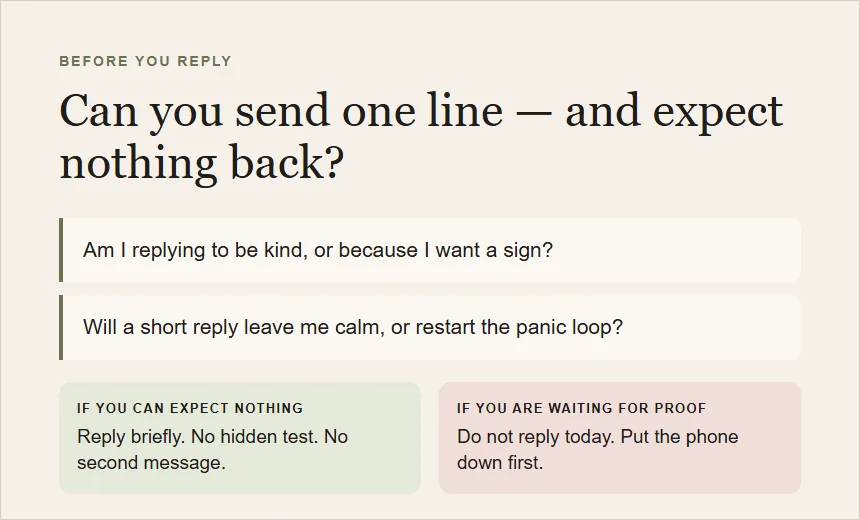
- Am I calm enough to accept any outcome?
- Would I still send this reply if I knew there would be no second message?
- Am I being polite, or am I trying to reopen the relationship?
- If they never contact me again, will I regret sending this?
- If they become warm again, can I demand clarity instead of surviving on hints?
If you cannot answer these questions honestly, wait.
You do not need to make a permanent decision while your nervous system is treating a text message like a fire alarm.
Ground your motive before touching the phone
If you find yourself opening and closing the messaging app, debating every punctuation mark, or feeling a sharp spike of anxiety, pause. You are trying to make a high-stakes decision while your nervous system is in emergency mode.
Before sending any reply, take two minutes with our free 3-Card No-Contact Reflection Tool. It does not predict the future; instead, it checks your immediate emotional reality:
- What is the documented fact? Separating the text itself from the narrative your brain built around it.
- What is your blind spot? The boundary or recurring pattern you are tempted to overlook in exchange for temporary relief.
- What is your grounded action? The next step that protects your dignity today, regardless of whether they reply or disappear.
If you need a third-party view to separate the birthday text from the story you stapled onto it, a written tarot reflection can work as a structured reflection tool—not magic, just a way to ask better questions before one polite “happy birthday” turns into a six-week emotional internship.
Taking a breath to inspect your motive protects you from turning a low-effort greeting into an emotional relapse.
The short answer
If your ex wished you happy birthday after no contact, you have three reasonable options:
Option one: Do not reply
Choose this if replying would pull you back into obsession, hope, or pain.
Option two: Send one brief thank-you
Use:
Thank you. I appreciate it.
Then stop. Let them make the next move if they actually want a real conversation.
Option three: Reply with a boundary
Use:
Thanks for the birthday wishes. I’m keeping some space for now. Take care.
This is useful when you want to be clear that politeness does not mean the relationship is reopening.
The safest default is simple:
Reply only if you can handle no response, a cold response, or a warm response that later disappears.
If you cannot handle those outcomes, do not reply yet.
A birthday text is not a command.
It is not a prophecy.
It is not proof that the relationship has changed.
It is one small action from another person. Your job is not to turn it into a future.
Your job is to protect your present.
Related guides for no-contact decisions
- Logistics vs. excuses: If you also have property left behind at an ex’s place, read our protocol on should I text my ex to get my stuff back during no contact.
- Silent views: If your ex observes your updates without sending a word, see our breakdown of what it means when he watches your stories but doesn’t text.
- Reconciliation reality check: Ground yourself in observable facts before assuming an ex is returning with is my ex coming back?.