
Relationships / reflection guide
He Watches My Stories but Doesn’t Text: What the Signal Can—and Cannot—Tell You
He watches your stories but does not text. Learn what a story view confirms, what it cannot prove, and how to decide whether reaching out makes sense.
The short answer
Seeing your story is one confirmed fact. It does not tell you whether he misses you, wants to reconnect, feels guilty, or plans to start a conversation.
That distinction is hard to hold because a story view is visible. Silence is not. The viewer list gives you a small piece of information at exactly the moment you want a much larger answer. You see his name, then your mind tries to supply the rest of the sentence.
A more honest way to read the situation is this:
A story view is evidence that someone saw your story. It is not evidence of what they feel, want, or plan to do.
That does not mean the view is meaningless. It means the view is narrow evidence. The useful question is not “What secret feeling does this prove?” It is “What else would I need to see before treating this as meaningful contact?”
The feeling is real. The interpretation is still unconfirmed.
What you actually know
Start with the smallest accurate sentence:
- His account viewed a story.
- It may have viewed more than one story.
- He did not send a message in the same moment.
- You do not know what he was thinking while he watched.
That is the observable layer. Keep it separate from the story your mind adds afterward.
| Observed behavior | What it tells you | What it does not prove |
|---|---|---|
| He viewed a story | The account was recorded as viewing it | That he misses you or wants to return |
| He views several stories | The account continued viewing that content | That he is monitoring you with a specific plan |
| He liked or reacted to one | He made a small visible response | That he is ready for a real conversation |
| He replies with a message | He chose direct contact at that moment | That he will be consistent afterward |
| He suggests a specific plan and follows through | There is clearer, reciprocal effort | That the relationship is repaired automatically |
The table is intentionally plain. Plain language is useful when you are tempted to promote a weak signal into a strong conclusion.
Why one story view can feel bigger than it is
A story view arrives without context. There is no tone of voice, no question, no explanation, and no risk taken by the person watching. The viewer list turns an absence of communication into a visible event, so it can feel like contact even when no conversation has happened.
After a breakup or during an unclear connection, that tiny event can become the day’s emotional headline. You check whether he viewed the next story. Then you compare the timing. Then you wonder whether a photo, song, or caption was meant to get a reaction.
Research on social-media use around relationship uncertainty and relationship endings helps explain why online visibility can become a place where people look for information. It does not identify the motive of one particular viewer. It cannot turn a platform record into proof of love, regret, jealousy, or a plan to return.
The gap between visible attention and direct effort is where most of the confusion lives.
What you cannot confirm from a view
A story view cannot answer these questions by itself:
- Does he still love me?
- Is he waiting for me to text first?
- Does he want to get back together?
- Is he jealous of someone in the story?
- Is he afraid of rejection?
- Is he checking whether I have moved on?
- Will he contact me later?
Any of these explanations is possible in some situation. None is established by the view alone.
There are also ordinary explanations that require no dramatic emotional theory: the app showed the story, he was passing time, he was curious, he tapped through quickly, or he has not made a decision about contact. You do not need to choose the most romantic explanation or the most painful explanation when the evidence does not distinguish between them.
Be careful with labels such as “avoidant.” Attachment research can describe broad patterns in relationships, but a label is not a remote diagnosis. It is not a substitute for observing what this person actually does with communication, boundaries, and follow-through.
Plausible explanations without mind-reading
If you want a short list, keep it short. Four possibilities are enough to show why the viewer list cannot settle the question:
- Curiosity or habit. He may be interested in what is happening in your life without wanting to reopen the relationship.
- Low-risk contact. Watching lets him remain near the edge of your life without having to start a difficult conversation.
- Routine access. Your story appeared, and viewing it required almost no deliberate decision.
- Unclear or changing feelings. He may have mixed feelings, but a mixed feeling is not the same as a clear intention.
These are possibilities, not a diagnosis. The important point is that several explanations fit the same visible behavior. When one weak signal supports many stories, it cannot tell you which story is true.
A hierarchy of stronger and weaker signals
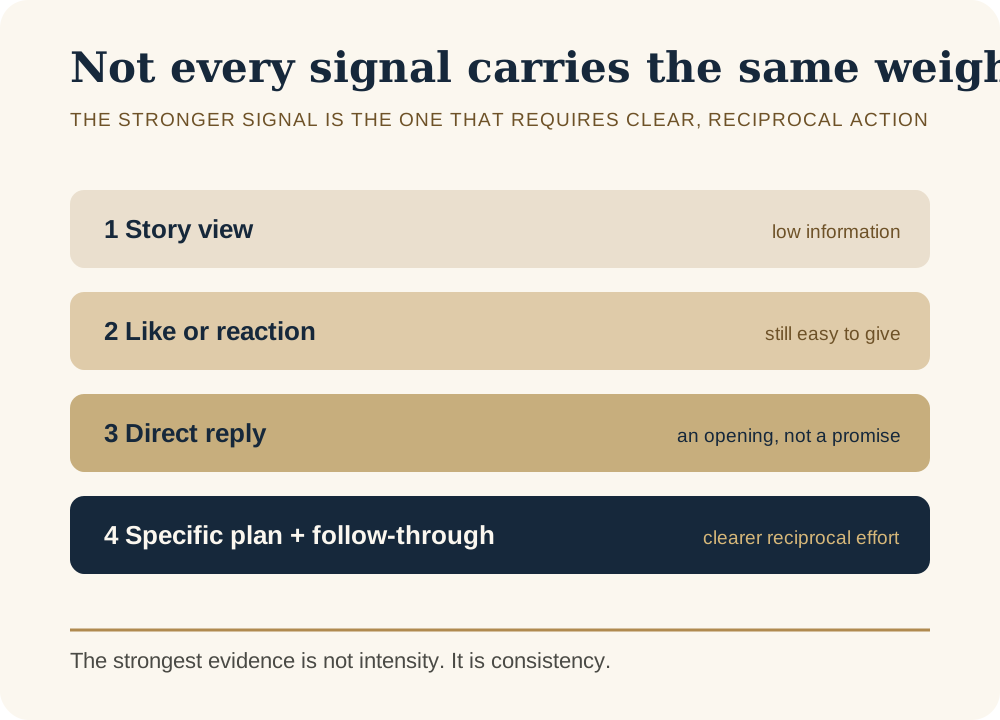
Not every online action carries the same amount of information. A practical hierarchy is:
story view < like or reaction < direct reply < sustained conversation < specific plan < consistent follow-through
This is not a law of relationships. A direct message can still be vague, and a plan can still be broken. The hierarchy is useful because each step generally contains more information about willingness to participate.
A view costs very little and leaves almost everything unknown. A direct reply at least creates an opening for conversation. A sustained exchange shows more than a single impulse. A specific plan answers a practical question: is this person willing to turn attention into time and action?
The strongest evidence is not intensity. It is consistency.
A fast view is still a view. A repeated view is still not a conversation. A like may show recognition or interest, but it does not automatically show readiness. Look for whether the person communicates clearly, responds to what you actually say, respects your boundaries, and follows through without making you carry the whole connection.
Should you text him?
Do not text solely to decode the view.
If the real message is “I saw that you watched my story—what does it mean?”, you are asking him to explain an interpretation that he may never have intended. You may also be placing yourself in a test: send a message, monitor the reply, and use the speed or warmth of the response as the next clue.
That can create a second round of uncertainty instead of resolving the first one.
Texting may make sense when all of these are true:
- you have a specific, ordinary reason to contact him;
- the message would still make sense if he had not viewed your story;
- you are not using the message to force a confession;
- you can accept no reply or a brief reply without sending another test message;
- the existing pattern is not one-sided or harmful to you.
For example, “Are we still on for Saturday?” is a concrete question. “Did you watch my story because you miss me?” turns a weak signal into a relationship examination.
Pause before sending if:
- you have already reached out several times without sustained effort from him;
- he replies warmly but never makes a clear plan;
- contact with him usually leaves you checking your phone for hours;
- you are hoping one message will make him choose the relationship;
- the story view is the only new information you have.
A message cannot manufacture reciprocal effort. It can reveal the current pattern, but only if you are prepared to accept what the pattern shows.
What to do with the viewer list
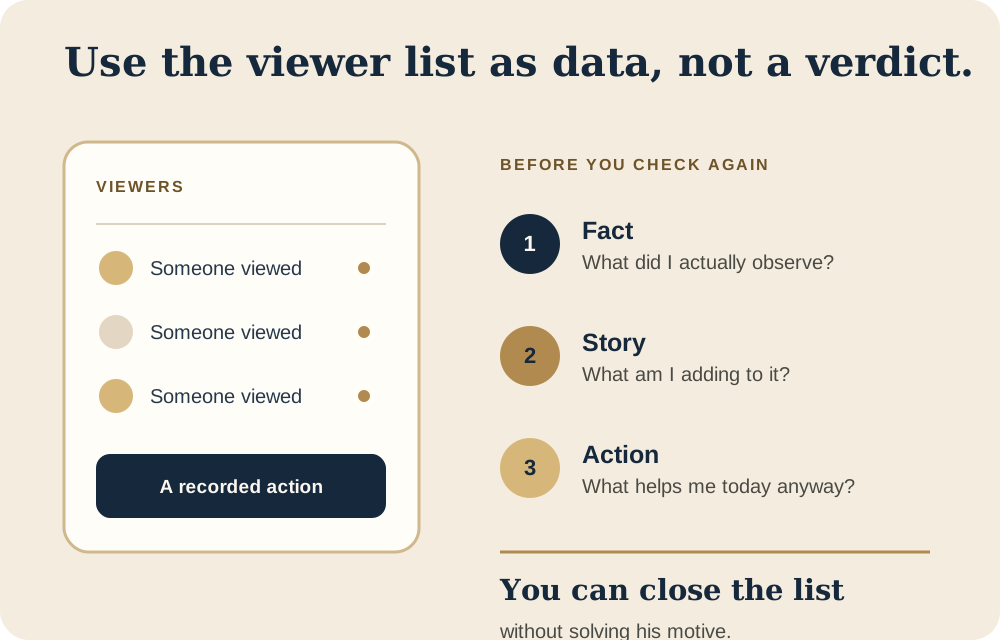
The viewer list is a source of information. It does not have to be a source of repeated exposure.
Try this three-line check before opening it again:
- Fact: What did I actually observe?
- Story: What am I adding to that observation?
- Action: What would help me today even if I never learn his motive?
If checking the list repeatedly increases hope, panic, or the urge to post something aimed at him, use a boundary. Mute his updates, hide your stories from him, restrict access, unfollow, or block if that is what you need. These are not tactics for making him react. They are ways to stop outsourcing your emotional state to a list of viewers.
You do not have to keep a door visible in order to prove that you are calm. Sometimes the most reality-based move is to remove the prompt that keeps restarting the same question.
A reality-based next step
Write down two columns:
What I know
- He viewed my story.
- He has or has not contacted me directly.
- He has or has not followed through on previous communication.
What I am guessing
- He misses me.
- He wants me to text first.
- He is afraid to say what he feels.
- He will come back if I wait.
Then choose one action that remains sensible under more than one explanation. You might wait instead of sending a test message. You might send one clear message for a real reason. You might stop checking the viewer list for a week. You might ask yourself whether this connection currently offers enough clarity and reciprocity to be good for you.
The point is not to become indifferent on command. It is to stop treating a low-information signal as if it owes you a high-confidence answer.
If you want a structured prompt for separating what happened from what you fear or hope it means, you can use the free reflection tools. They are for organizing your own thinking—not for reading his mind, predicting contact, or promising reconciliation.
The short version
The view is a fact. The meaning you attach to it is still a hypothesis.
A story view costs less than a conversation, so it carries less information.
Do not text to decode a view. Text only if you have something real to say and can handle silence.
If you find yourself stuck in repetitive loop thoughts and want an outside perspective to help organize your choices rather than divine his thoughts, an affordable written tarot report with fixed scope can provide reflective distance without open-ended hourly billing.
Sources behind this framework
The article uses relationship and social-media research as background for the uncertainty framework, not as a way to infer the motives of an individual viewer:
- Marshall, T. C. (2012), research on Facebook surveillance, breakup-related distress, longing, and recovery. The study can support discussion of post-breakup monitoring and emotional uncertainty; it cannot explain why a specific person viewed a story.
- Fox, J. and Warber, K. M. (2014), research on relationship uncertainty, attachment-related variables, and partner surveillance on Facebook. It can support discussion of online monitoring as a response to uncertainty; it cannot diagnose attachment style or prove intent.
- Research on Facebook use during relationship termination, including uncertainty reduction and surveillance. It can support the distinction between online visibility and direct communication; it cannot predict whether an ex will reach out.
Research on social media is mixed and context-dependent. None of it turns a story view into a promise.
Where to go next
Series
No Contact & Ex-Texting Decision Guides
These guides separate visible contact from the story you may be adding to it.